




FLUID MECHANICS : AN INTRODUCTION TO PHYSICAL PROPERTIES OF FLUID
Section outline
-
The Adventures of Little Water Drop: A Fluid Mechanics Story
Introducing Pip
Meet Pip, a cheerful little Water Drop! Pip lived in a big, blue swimming pool and loved to play. One sunny morning, Pip decided to learn about what makes all his friends—water, honey, and even the air so special. He wanted to understand their physical properties!

What is a Fluid?
Pip asked the wise Old Professor Air Bubble, "Professor, what is a fluid?" The Professor chuckled. "That's a great question, Pip! A fluid is anything that can flow and easily change its shape to fit its container. Water, oil, and even the air around us are all fluids! We don't have a fixed, rigid shape like a rock."

The Secret of Density
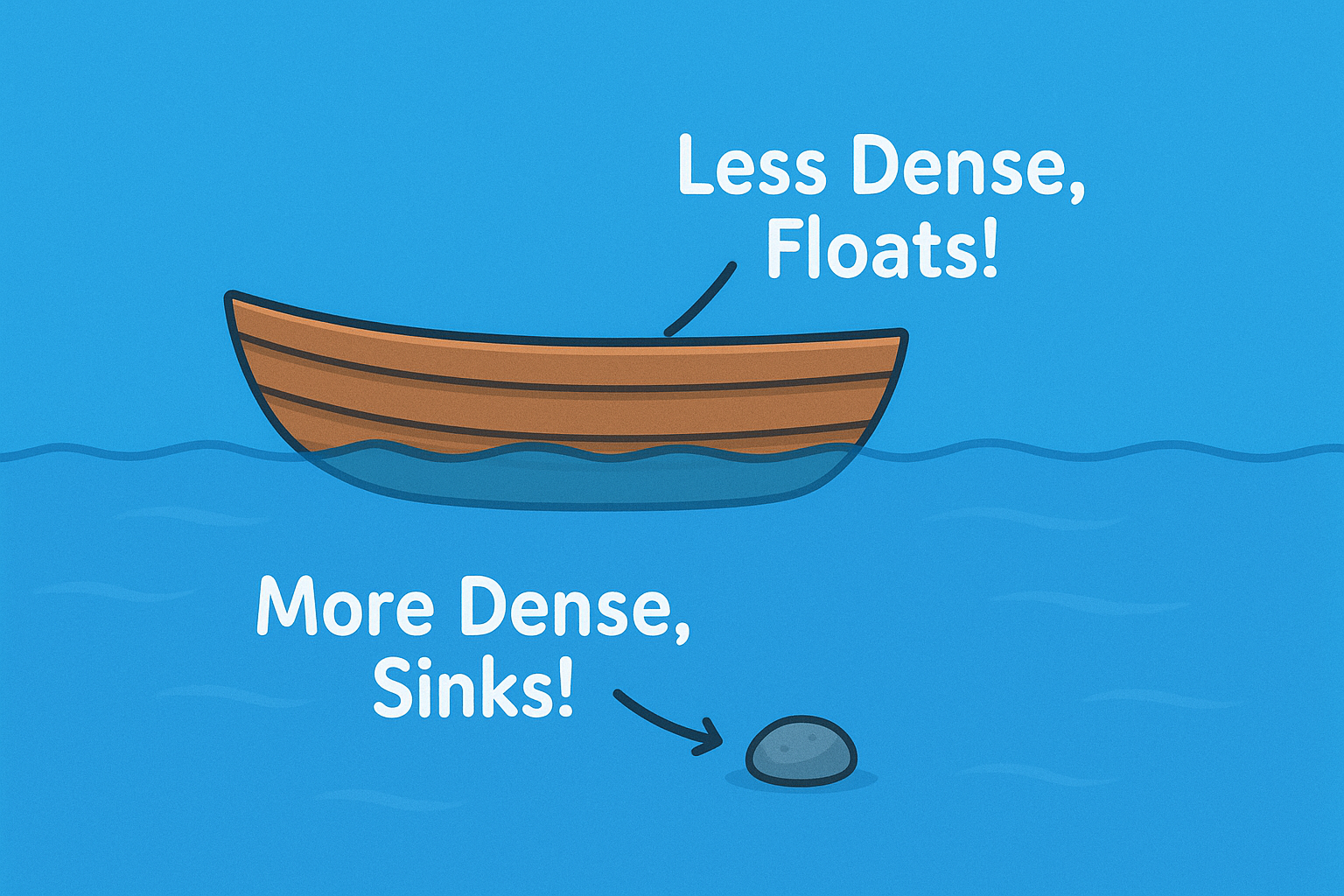
Pip saw a little pebble sink quickly to the bottom, while a big wooden toy boat floated merrily on top. "Why does that happen?" he wondered. "That's because of Density," explained the Professor. Density is how much 'stuff' (mass) is packed into a certain space (volume).
Pebble : Has high density, so it sinks!
Boat : Has low density, so it floats!"We calculate it like this: Density (ρ) = Mass (m) / Volume (V)," said the Professor.
The Mystery of Viscosity
Next, Pip visited two friends: fast-flowing River Water and slow-moving Honey. "Try to stir us!" they challenged. Stirring the River Water was easy—it barely resisted! But stirring the thick Honey was very hard. "That difference is called Viscosity," said Pip. Viscosity is a fluid's resistance to flow.
River Water : Has low viscosity; it flows easily and quickly.
Honey : Has high viscosity; it flows slowly and is thick and sticky!
The Push of Pressure
Pip dove deep down to the bottom of the pool. He felt a big push all around him! It was the weight of all the water above him pressing down. "That push is Pressure," the Professor called out from above. Pressure (P) is a force applied over an area.
The deeper Pip went, the greater the pressure became! That's why deep-sea creatures need special bodies!

The Lift of Buoyancy
As Pip swam back up, he felt a wonderful, helpful force pushing him up! It was the Buoyant Force!
Buoyancy is the upward push a fluid gives an object. The Buoyant Force is equal to the weight of the fluid that is pushed aside by the object (Archimedes' Principle). This is what helps the big boat float!

Pip's Discovery
Pip swam back to the sunny surface, feeling very smart! He learned that all fluids have amazing physical properties:
1. Density (how much stuff is packed in)
2. Viscosity (how easily it flows)
3. Pressure (the push from the fluid's weight)
4. Buoyancy (the upward push)Understanding these things helps engineers design ships 🚢, build airplanes ✈️, and even predict the weather!
"Hooray for Fluid Mechanics!" cheered Pip.

-
-
-
-
-
Students mustMark as done
Try ur understanding with this fun game
-
-
-
-
-
-
-
-
-