




ACID AND BASE
Section outline
-
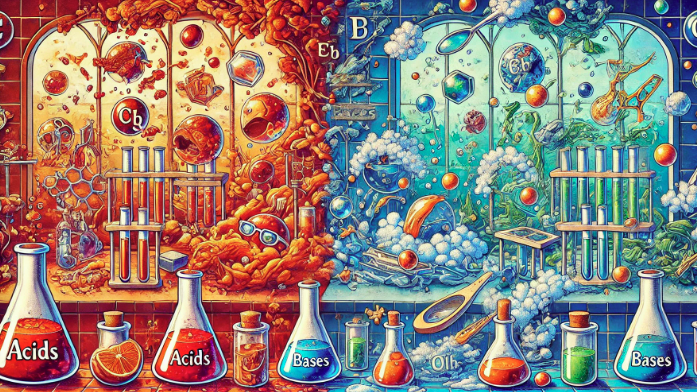
Explore the essential concepts of acids and bases, including definitions by Arrhenius, Bronsted-Lowry, and Lewis theories. Learn to calculate pH, pOH, and understand their relationship. Gain insights into titration techniques, equivalence points, and the role of indicators. Engage in practical problem-solving, real-life applications, and visual demonstrations to strengthen your understanding. Perfect for students preparing for exams or chemistry enthusiasts aiming to deepen their knowledge. Join now for interactive lessons and quizzes!
Welcome to our online course on Acids and Bases! This course covers two key topics: pH and pOH and Titration. Complete both topics to earn your badge. Have fun and enjoy learning!
-
-
Students mustView
Students will understand that pH and pOH measure the acidity and basicity of solutions. pH measures the concentration of hydrogen ions (H⁺), with values below 7 being acidic and above 7 being basic. pOH measures the concentration of hydroxide ions (OH⁻), with values below 7 being basic and above 7 being acidic. At 25°C, the sum of pH and pOH is always 14. This concept helps students relate acidity and basicity to ion concentration in aqueous solutions.
-
Students mustMark as done
Welcome to Exploring Acidity and Alkalinity: pH and pOH Discussions. This forum is dedicated to understanding the principles, calculations, and real-world applications of pH and pOH. Whether you're a student, researcher, or enthusiast, this is the place to:
• Discuss the fundamental concepts of pH and pOH and their role in chemistry.
• Explore calculation techniques for pH, pOH, and ion concentrations.
Join the conversation to deepen your knowledge and exchange ideas in the fascinating field of acid-base chemistry!
o What are pH and pOH, and how are they related?
o How do pH and pOH reflect the acidity or basicity of a solution?
o Why is the pH scale typically between 0 and 14?
o How does the ionization of water influence pH and pOH?
o Why does pH plus pOH always equal 14 at 25°C?
o What happens to pH and pOH at different temperatures?
o How do strong acids and bases differ from weak ones in terms of pH?
o Why does a neutral solution have a pH of 7?
-
-
Students mustMark as done
-
-
-
Students mustMark as done
Acid-base titration is a laboratory technique used to determine the concentration (molarity) of an unknown acid or base solution. By gradually adding a solution of known molarity (the titrant) to the unknown solution, the reaction reaches the equivalence point, where moles of acid equal moles of base. Indicators or pH meters are used to detect this point. This method is essential in analytical chemistry for precise concentration measurements.
-
-
Students mustMark as done
Anyone interested in the fascinating world of acid-base titrations? Whether you're a student trying to master the technique or an expert with tips to share, I'd love to hear your thoughts! Let's discuss everything from choosing the right indicator, to understanding titration curves, to troubleshooting common issues in the lab. Got any interesting experiences, challenges, or tips to make titrations more accurate and efficient? Jump in and share your insights — let’s learn together!
-
-

CONCLUSION:
In conclusion, acids and bases are essential chemical concepts with wide-ranging applications. Acids release hydrogen ions (H⁺), while bases release hydroxide ions (OH⁻) in solutions. Understanding pH and pOH helps measure their strengths, and titration enables precise determination of their molarity. Mastering these principles is crucial for analyzing chemical reactions, solving real-world problems, and advancing in fields like medicine, agriculture, and environmental science.
REFERENCE:
Wang, Y., Geng, J., & Zhu, Z. (2024). A Comprehensive Teaching Laboratory Program on Titration Analysis: Transition from Classic to Modern Approaches. Journal of Chemical Education, 101(2), 612-620.
Yun, T. Y., & Chandler, B. D. (2023). Surface hydroxyl chemistry of titania-and alumina-based supports: quantitative titration and temperature dependence of surface Brønsted acid–base parameters. ACS Applied Materials & Interfaces, 15(5), 6868-6876.
Dias, L. G., Duarte, L. C., Pinheiro, K. M., Moreira, N. S., & Coltro, W. K. (2023). Distance-based paper microfluidics as environmentally friendly platforms for monitoring acid-base titrations. Talanta Open, 7, 100216.
Clark, T. M., Anderson, E., Dickson-Karn, N. M., Soltanirad, C., & Tafini, N. (2023). Comparing the Performance of College Chemistry Students with ChatGPT for Calculations Involving Acids and Bases. Journal of Chemical Education, 100(10), 3934-3944.
Dilmuradovna, J. S. (2024). Titration of Rare Metals with DMGO Solutions in Non-Aqueous Media. EUROPEAN JOURNAL OF INNOVATION IN NONFORMAL EDUCATION, 4(3), 88-89.