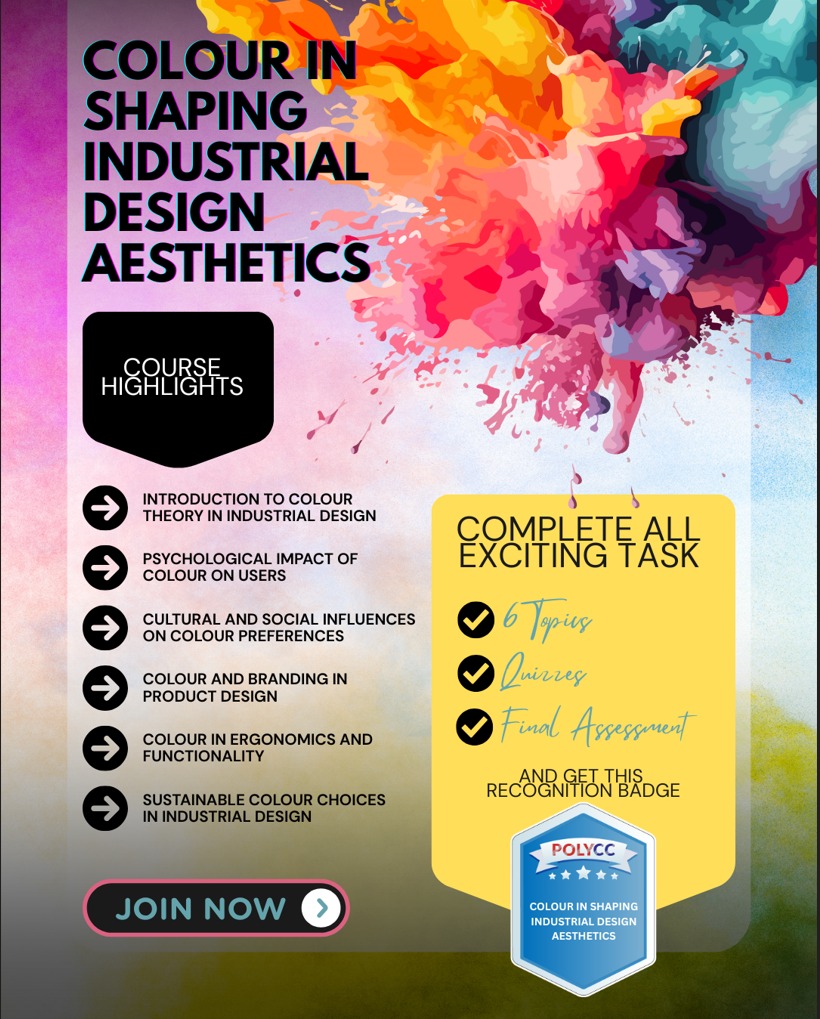




COLOUR IN SHAPING INDUSTRIAL DESIGN AESTHETICS
Section outline
-
Welcome to a journey of creativity: uncover the power of colors in industrial design aesthetics!
Have you ever noticed how a single shade can make a product look cool, bold, or even futuristic? In industrial design, colours are like magic, they shape style, set the mood, and make everyday objects stand out. Let’s dive in and see how each colour tells its own story!
-
-
In this topic, you will learn:
-
The basics of the color wheel and color relationships
-
The role of color in enhancing product aesthetics and usability
-
-
In this topic, you will learn:
-
How different colors affect mood, emotion, and behavior
-
The psychological meanings commonly associated with key colors
-
Colors & Emotions: The Secret Language of Shades! Video Time
-
The Power of Color: Mood Board Exploration! Lesson
-
-
In this topic, you will learn:
-
How cultural backgrounds shape color associations and meanings
-
Differences in color preferences across regions, age groups, and social demographics
-
Colors and Their Influence on Culture and Psychology Video Time
-
Cultural Symbolism of Color Lesson
-
Social Influences on Colour Preferences Lesson
-
-
In this topic, you will learn:
-
The role of color in building brand identity and recognition
-
How specific colors evoke brand values
-
Role of Colour in Product Design Lesson
-
Colour and branding Video Time
-
Psychological Associations of Key Colors in Branding Lesson
-
QUIZ 2: Tap to Test Your Color Brands! Interactive Content
-
-
In this topic, you will learn:
-
How color enhances usability and accessibility in product design
-
The use of contrast, brightness, and color coding for improved functionality
-
Colour in Ergonomics and Functionality Lesson
-
QUIZ 3: Tap to Test Your Colour In Ergonomics And Functionality! Interactive Content
-
-
In this topic, you will learn:
-
How to choose eco-friendly pigments, dyes, and finishes
-
The environmental impact of various coloring processes and materials
-
What Is Sustainable Colour in Industrial Design? Lesson
-
Why Sustainable Colour important in Industrial Design? Lesson
-
-
-
Assessment 1 Quiz
INSTRUCTIONS:
-
This assessment consists of 20 multiple-choice questions (MCQs).
-
Each question has only one correct answer.
-
Read each question carefully before selecting your answer.
-
Once you have selected your answer, click/choose the option (A, B, C, or D).
-
The quiz must be completed within the allocated time.
-
Do not close or refresh the browser window while attempting the quiz.
-
Attempt all questions before submitting your answers.
-
Your final score will be determined by the total number of correct responses.
GRADING:
-
Each correct answer = 5 mark
-
Each incorrect or unanswered question = 0 mark
-
Total marks available = 100 marks
-
Time limit: 30 mins
-
-
-
Congratulations! 🎉🎉🎉
You have successfully completed Colour in Shaping Industrial Design Aesthetics.
Throughout this micro-credential course, you have learned to:
-
Understand the fundamentals of colour theory and apply them in design compositions.
-
Use colour psychology to influence user emotions, perceptions, and decision-making.
-
Recognize the role of cultural and symbolic meanings in choosing appropriate colours for global audiences.
-
Apply sustainable colour choices to communicate environmental awareness and responsible design.
-
Integrate ergonomics and functionality through colour coding for safety, usability, and comfort.
-
Analyse real-world industrial design case studies to see how brands use colour for identity and impact.
-
Develop design concepts that combine aesthetic appeal with practical purpose through strategic use of colour.
You are now equipped with the knowledge and practical insights to make effective, creative, and responsible colour choices in industrial design. These skills will serve as a strong foundation for future design projects, advanced studies, or professional practice.
-
Feedback Form
-
-
BOOKS:
-
Birren, F. (2012). Color Psychology and Color Therapy. Pickle Partners Publishing.
– A classic on psychological and emotional effects of colour. -
Heller, E. (2009). Psychology of Color: How Colors Affect Us and How We Affect Colors. Universe.
– Explores cultural and psychological aspects of colour. -
Walch, V. (2002). Color Theory: An essential guide to color. Chartwell Books.
– Practical reference on colour theory and application.
JOURNALS & ARTICLES:
-
Ou, L. C., et al. (2004). “A Study of Colour Emotion and Colour Preference. Part I: Colour Emotions for Single Colours.” Color Research & Application, 29(3), 232–240.
-
Sonderegger, A., & Sauer, J. (2010). “The Influence of Design Aesthetics in Usability Testing: Effects on User Performance and Perceived Usability.” Applied Ergonomics, 41(3), 403–410.
-